

Because it sits right inside Qualtrics, Text iQ is convenient. That's exactly why so many teams start with it.
However, you may have found yourself quickly outgrowing its capabilities, especially as your need for more sophisticated data processing and analysis grows.
A tracker needs the client's codebook applied exactly. A brand question needs every misspelling of every competitor caught. A multi-market study arrives in a language Text iQ doesn't support. Suddenly, the convenient option means hours of query building and manual tagging.
If that's where your team is, a dedicated open-ended survey coding platform is likely a better fit. Below, we compare seven Qualtrics Text iQ alternatives on the capabilities that matter most to research teams, from code frame control to crosstabs and AI analysis.
What Qualtrics Text iQ does well
Text iQ is the text analysis module built into Qualtrics. Its biggest strength is convenience: open-ended responses are analyzed right next to the rest of your survey data, with no exports or extra tools.
You can build topics by tagging responses, searching for keywords, or writing queries. Topics can be nested into hierarchies, one response can carry several topics, and topic variables can be analyzed against satisfaction scores and demographics in Stats iQ. Advanced licenses add recommended topics, sentiment analysis, and translation of comments.
For teams that live in Qualtrics and need a quick read on open-text feedback, that's often enough. But, for others, the limitations quickly become clear.
Here's where research teams tend to hit its limits.
Text iQ's limitations: Why your team might need something more powerful
There are a few common cases where teams find Text iQ limiting, from lacking nuance to slow updates:
Topic building leans on keywords and queries
Much of Text iQ's topic setup relies on keyword searches and query logic. That works for clear-cut topics, but nuanced responses, negation, and sarcasm can take a lot of manual tagging. Getting a client's detailed code frame applied accurately often takes more setup than in AI-native coding tools.
Important features depend on your license
Recommended topics, sentiment analysis, the query builder, and comment translation are all Advanced features. Basic licenses are also limited to 20,000 responses per survey, which large trackers can outgrow.
Language support is limited
Text iQ supports 14 languages, including English, Spanish, German, French, Japanese, and Simplified Chinese. Multi-market studies outside that list, or datasets that mix languages, need another approach.
Changes take time to reach reports
Text iQ saves topic edits as drafts that apply once you publish them, and Qualtrics notes that published changes can take anywhere from 30 minutes to 48 hours to show up in reports. That slows down the review-and-refine loop that good coding depends on.
8 Things to compare in a Text iQ alternative
These are the capabilities we used to evaluate each platform below. Keep in mind that the right mix depends on whether your main output is a research report, a dashboard, or both.
1. Code frames: AI-generated or your own
The best platforms do both. They can build a code frame from your responses, or apply your existing codebook so tracker waves and client specs stay consistent.
2. Multi-code and single-code attribution
Responses often mention several ideas. You'll want multi-code attribution by default and the option to switch to single-code when a question needs one primary answer.
3. Entity coding alongside thematic coding
Questions like "Which brands have you bought recently?" need entity coding that standardizes names and catches misspellings. Theme-only tools treat those answers like any other text.
4. Researcher review and editing
Look for response-level review and quick ways to merge, split, rename, and reassign codes, with every code linked back to its verbatims.
5. Exports for your workflow
If your team works in SPSS, Q, or Excel, check that coded data exports cleanly. If you'll bring codes back into Qualtrics, check that too.
6. Language coverage
Confirm the platform covers every language in your upcoming studies and applies one code frame consistently across them.
7. Crosstabs and significance testing
The most efficient platforms let you treat codes as variables right away, with segment cuts and significance tests in the same place.
8. AI exploration beyond the code list
Chat-style analysis lets you ask why a segment feels the way it does, then trace the answer back to the responses behind it.
Qualtrics Text iQ alternatives: A quick comparison
Here's the short version of where each platform fits, followed by a feature comparison that includes Text iQ.
First, let's take a look at each platform's strengths:
| Platform | Best for |
|---|---|
| BTInsights | Market research coding, crosstabs, and sophisticated AI analysis |
| Displayr | Crosstabs and reporting |
| Codeit | Dedicated coding workflow |
| Caplena | Stronger text analysis |
| Thematic | Automated theme discovery in feedback |
| Ascribe | Agencies with dedicated coding teams |
| Chattermill | CX teams analyzing feedback across channels |
Next, let's zero in on specific capabilities and compare feature sets:
| Platform | AI + own code frames | Multi-code | Entity coding | Human review | Multilingual | Crosstabs + sig testing | AI chat exploration |
|---|---|---|---|---|---|---|---|
| BTInsights | Yes | Yes | Yes | Yes | Yes | Yes | Yes |
| Qualtrics Text iQ | Yes | Yes | Partial | Yes | Yes | Partial | Partial |
| Displayr | Yes | Yes | Partial | Partial | Yes | Yes | Partial |
| Codeit | Yes | Yes | Yes | Yes | Yes | Partial | Partial |
| Caplena | Partial | Yes | Partial | Yes | Yes | Partial | Yes |
| Thematic | Partial | Yes | Partial | Yes | Yes | Partial | Yes |
| Ascribe | Yes | Yes | Partial | Yes | Yes | Partial | Partial |
| Chattermill | No | Yes | Partial | Yes | Yes | Partial | Yes |
"Partial" means the feature is limited.
7 Best Qualtrics Text iQ alternatives for open-ended survey coding
Now that we've covered some of the most important top-level comparison items from strengths to feature sets, let's take a closer look at each individual alternative on our list.
Each was chosen because it's either a strong all-around alternative, or it excels compared to Qualtrics Text iQ in one specific area:
1. BTInsights: Best overall Text iQ alternative for market research coding
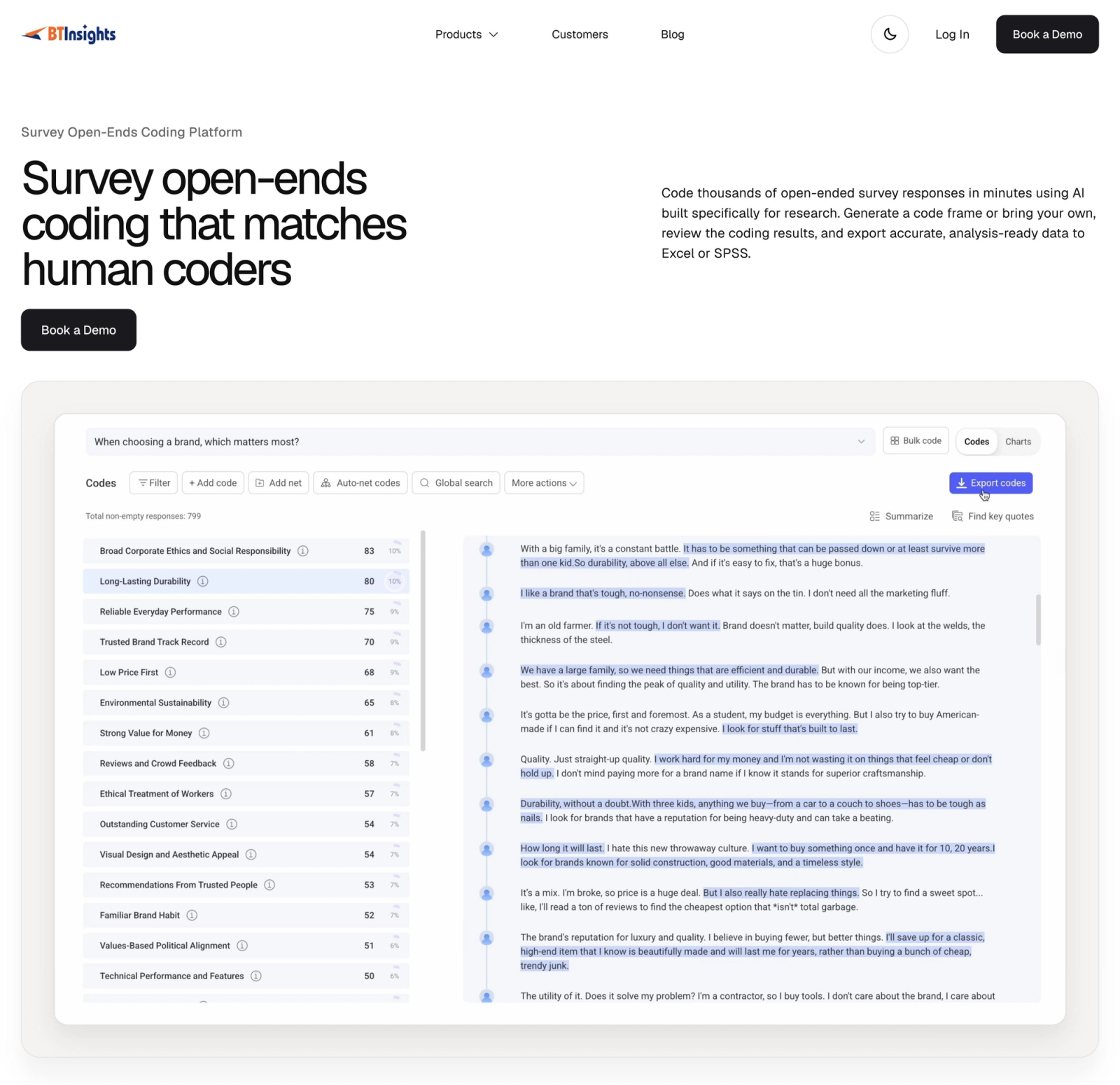
BTInsights is an AI-native platform built specifically for market research teams that code and analyze open-ended survey responses. It handles the coding jobs that are hardest in Text iQ, such as applying a detailed client codebook, coding brand mentions, and working across many languages.
- AI or existing code frames: Let AI build a code frame from your responses, or upload a codebook and have responses assigned to your predefined codes.
- Thematic and entity coding: Code reasons and motivations, or extract entities such as brands and places while recognizing alternate names for the same one.
- Single-code and multi-code: Choose one code per response or every code that applies.
- Full researcher control: Review assignments, move responses, and split, merge, rename, or group codes, with every code linked to its verbatims.
- 50+ languages: Code and translate responses in more than 50 languages, including mixed-language datasets.
- Crosstabs, sig testing, and chat: Cut codes by segment, run significance tests, and ask follow-up questions of the responses in plain language.
Coded results export to Excel, SPSS, and Q, so they fit into existing workflows. Abacus Data, for example, moves open-ends from Q into BTInsights and back again. On larger studies, coding that took about two weeks now takes around 20 minutes. As senior analyst Michael Monopoli puts it, "It turns big, overwhelming, scary projects into something that can be done."
BTInsights is SOC 2 Type II audited, and customer data is never used to train AI models.
Explore BTInsights Survey Open-Ends Coding.
2. Displayr: Best for advanced crosstabs and reporting
Displayr is a survey analysis and reporting platform known for cross-tabulation, weighting, significance testing, and dashboards. For teams that find Stats iQ limiting, it's a strong step up on the quantitative side.
Its text categorization tools use AI to identify themes and assign one or several categories per response, and existing code frames can be reused across variables. Custom AI prompts handle tasks such as sentiment analysis and entity extraction, and results export to PowerPoint, Excel, and PDF.
Having said that, Displayr's coding review and editing tools are more limited than a dedicated coding platform's. It suits teams where quant analysis comes first and open-ends are one part of the story.
3. Codeit: Best for a dedicated, traditional coding workflow
Codeit is a purpose-built verbatim coding platform for market research. It builds a codeframe and autocodes responses with its Extract feature, lets researchers refine the output, and uses machine learning to apply past coding to new data on trackers.
Brand Coding catches brand mentions however they're spelled, and auto-translation covers more than 130 languages, which addresses two of Text iQ's biggest gaps. Deep Dive answers natural-language questions about coded data with charts and example verbatims.
Codeit produces charts and crosstabs, but significance testing isn't documented. Pricing is volume-based with an annual commitment and a 30-day free trial.
4. Caplena: Best for teams that runs continuous feedback program
Caplena is an AI feedback analysis platform with a direct Qualtrics integration, so survey data can flow in without manual exports. It builds codebooks quickly, lets you refine topics as you go, and analyzes text in more than 100 languages.
Its Insight Agent answers questions about your feedback, and driver analysis highlights which topics move your scores most. Data can also come in from Excel, SPSS, and platforms such as Medallia.
Caplena is built mainly around continuous CX and employee feedback. Teams coding project-based market research studies should confirm codebook import and export options.
5. Thematic: Best for automated theme discovery in feedback
Thematic discovers themes from feedback automatically, so you don't need to build topics with keywords or queries first. Themes are hierarchical, each comment can carry multiple themes, and a theme editor lets you merge, rename, split, and add themes.
It includes sentiment analysis, built-in translation, segment comparisons with significance testing, and an Answers feature for plain-language questions.
Thematic is a strong fit for exploratory and ongoing feedback analysis. Teams that need to apply a fixed or client-supplied code frame should check how much control it gives them up front.
6. Ascribe: Best for agencies with dedicated coding teams

Ascribe is a long-established verbatim coding tool built around codebooks, coder assignments, and team management. It suits agencies that run high volumes of coding with in-house staff.
Its AI features include Theme Extractor for codebook generation and coding, Ask Ascribe for plain-language questions, and Coding Assistant and Lightning Mode for code suggestions. Results export to SPSS.
Crosstabs and trend reporting are part of Ascribe's separate CX Inspector product, and pricing isn't published.
7. Chattermill: Best for CX teams analyzing feedback across channels
Chattermill is a customer intelligence platform that combines surveys with reviews, support chats, and calls across more than 65 channels. It tags feedback into a taxonomy automatically, applies aspect-based sentiment, and supports more than 100 languages with automated translation.
Its Lyra AI agent answers custom questions with supporting quotes, and dashboards track NPS, CSAT, and sentiment over time, with impact analysis and anomaly detection.
Chattermill is a good fit for in-house CX teams that use Qualtrics alongside other feedback sources. It's less suited to project-based research built around a specific code frame, crosstabs, and client deliverables.
How to test a Text iQ alternative without leaving Qualtrics
Switching coding tools doesn't mean switching survey platforms. Many teams keep fielding in Qualtrics and move only the coding. Here's a simple way to test it:
- Export the open-ended responses from a recent Qualtrics survey, along with the key segments you report on.
- Code them in the new platform, using your existing topic list or codebook as the starting code frame.
- Compare results against your Text iQ topics, paying close attention to nuanced, multi-topic, and brand responses.
- Run the crosstabs and significance tests you'd normally include in the report.
- Check that the coded output imports cleanly into Qualtrics, SPSS, or wherever your reporting happens.
The UNH Survey Center follows a similar pattern with its own tools. The team exports open-ends to Excel, applies the client's existing codes in BTInsights, reviews the results, and brings them back into SPSS. Project director Sean McKinley says, "It's as if we had someone who was doing all of the work that we used to do ourselves."
For more on how the main tools compare beyond Text iQ, see our guide to the best survey text analysis software for market research.
Get Research-Grade Coding Without Rebuilding Your Workflow
Text iQ is convenient. But when the work calls for a client's codebook, brand coding, or a dozen languages, convenience turns into hours of query building and manual tagging.
BTInsights was built to fix that:
- Your codebook, applied accurately: Upload an existing code frame or let AI build one, then review every assignment.
- Themes and entities: Code motivations and brand mentions in the same platform.
- More than 50 languages: Apply one code frame consistently across every market.
- Analysis built in: Run crosstabs and significance tests, then ask follow-up questions of the responses.
Keep fielding in Qualtrics and see the difference in your coding. Book a demo with BTInsights.