

Codeit does what it was designed to do. It builds a codeframe, codes your verbatims, and gives your team a solid environment for refining the results.
But coding is rarely where a project ends, and you may have found that the work slows down at everything that comes after it.
The client wants the top themes cut by region, weighted, with significance testing. The coded file heads to Q or SPSS so someone can rebuild the tables there. Then a new question comes in from the client, and the round trip starts over. Meanwhile, the annual commitment renews whether your project volume went up or down this year.
If that sounds familiar, a platform that handles coding and analysis in one place is likely a better fit, and several alternatives now do more of that work than Codeit.
Below, we compare six Codeit alternatives on the features that matter most for open-ended survey coding, so you can find the right fit for your team.
What Codeit does well
Codeit, from London-based Digital Taxonomy, is a purpose-built platform for coding open-ended survey responses. It's a familiar name at research agencies, and it fits traditional codeframe-led workflows well.
Its Extract feature builds a codeframe and autocodes your data, while Refine lets researchers check and adjust the output. Machine learning trained on your past coding applies the same logic to new data, which is useful for trackers. Brand Coding catches brand mentions however they're spelled, auto-translation covers more than 130 languages, and Deep Dive answers natural-language questions with charts, summaries, and example verbatims.
For teams that want a specialist coding environment, that's a strong package. Here's why some teams still look for something else.
Codeit limitations: Why teams look for alternatives
Below is a quick list of typical reasons we've seen that teams look for Codeit alternatives for open-ended survey coding:
Analysis usually continues in another tool
Codeit's Visualize feature turns coded data into charts and crosstabs, but significance testing isn't part of its documented feature set. Teams whose reports depend on weighted crosstabs and sig testing often still export to Q, SPSS, or a tab tool to finish the job.
The AI sits on top of a traditional workflow
Codeit has added AI to a codeframe-first process. That's a good fit for teams that want to stay close to manual coding, but teams that want AI to code the whole dataset first and spend their time reviewing it may find AI-native platforms faster.
Pricing requires an annual commitment
Codeit's pricing is volume-based, so you pay for the verbatims you code, and there's a 30-day free trial. Even so, one practitioner review notes the downside: “It's an annual commitment, and in a world of ever-changing SaaS solutions, you like to keep your options open.”
8 Things to look for in a Codeit alternative
At this point, the limitations are clear, and you probably already have some idea of what you want instead.
Before we break down the list of alternatives, use the questions below to narrow your shortlist. What is it exactly that you're looking for in a Codeit replacement?
These are the same criteria we used to compare each platform below:
1. Can it build a code frame and apply yours?
AI-generated code frames save time on new studies. Trackers and client projects need the opposite: your existing codebook applied consistently, wave after wave. You want both options in one tool.
2. Does it handle multi-code and single-code attribution?
Most open-ends mention more than one idea, so multi-coding should be the default. But some questions call for one primary code per response, so the platform should let you choose.
3. Can it code entities as well as themes?
Brand, store, and product questions need entity coding that recognizes spelling variations and nicknames. Since entity coding is one of Codeit's strengths, make sure any replacement matches it.
4. How much control do researchers have?
Look for response-level review, easy merging, splitting, and renaming of codes, and the ability to move responses between codes. Every code should trace back to the verbatims behind it.
5. Will the exports fit your workflow?
Check that coded data exports cleanly to the tools your team already uses, such as Excel, SPSS, or Q, without manual rework.
6. How does it handle other languages?
For multi-market studies, the same code frame should apply consistently across languages, including datasets where respondents mix languages.
7. Can you analyze codes without exporting?
Crosstabs and significance testing on coded data save hours on every project. This is the gap most Codeit users are trying to close.
8. Can you ask questions beyond the code list?
A chat interface lets you follow up on what the codes show, like what dissatisfied customers in one region actually said about support. Codeit's Deep Dive covers some of this, so compare how far each alternative goes.
Codeit alternatives: A quick comparison
Now, let's take a look at each of our alternatives from a purely strengths and features perspective.
Before covering each alternative in greater detail, here's where each of our choices stood out when compared to Codeit:
| Platform | Best for |
|---|---|
| BTInsights | Coding plus crosstabs, sig testing, and AI analysis |
| Ascribe | Agencies with a dedicated coding team |
| Displayr | Quant-heavy teams that also code open-ends |
| Caplena | Ongoing CX and feedback analysis |
| Qualtrics Text iQ | Qualtrics-first teams |
| Thematic | Discovering themes you didn't plan for |
Next, let's take a look at a quick breakdown that shows how each of our alternatives stacks up to Codeit purely from a feature standpoint:
| Platform | AI + own code frames | Multi-code | Entity coding | Human review | Multilingual | Crosstabs + sig testing | AI chat exploration |
|---|---|---|---|---|---|---|---|
| BTInsights | Yes | Yes | Yes | Yes | Yes | Yes | Yes |
| Codeit | Yes | Yes | Yes | Yes | Yes | Partial | Partial |
| Ascribe | Yes | Yes | Partial | Yes | Yes | Partial | Partial |
| Displayr | Yes | Yes | Partial | Partial | Yes | Yes | Partial |
| Caplena | Partial | Yes | Partial | Yes | Yes | Partial | Yes |
| Qualtrics Text iQ | Yes | Yes | Partial | Yes | Yes | Partial | Partial |
| Thematic | Partial | Yes | Partial | Yes | Yes | Partial | Yes |
“Partial” means the feature is limited.
Lastly, we'll take a look at each alternative in more detail to see what makes it special, and when and why you might consider it as an alternative to Codeit.
The 6 best Codeit alternatives for open-ended survey coding
Each alternative below was chosen based on its ability to either:
- Do something Codeit does better (i.e. the limitations we talked about earlier)
- Do something that Codeit doesn't offer at all
- Or, serve as a better all-around alternative that does both
Here are our choices for best Codeit alternatives for open-ended survey coding and why:
1. BTInsights: Best overall Codeit alternative for coding plus analysis
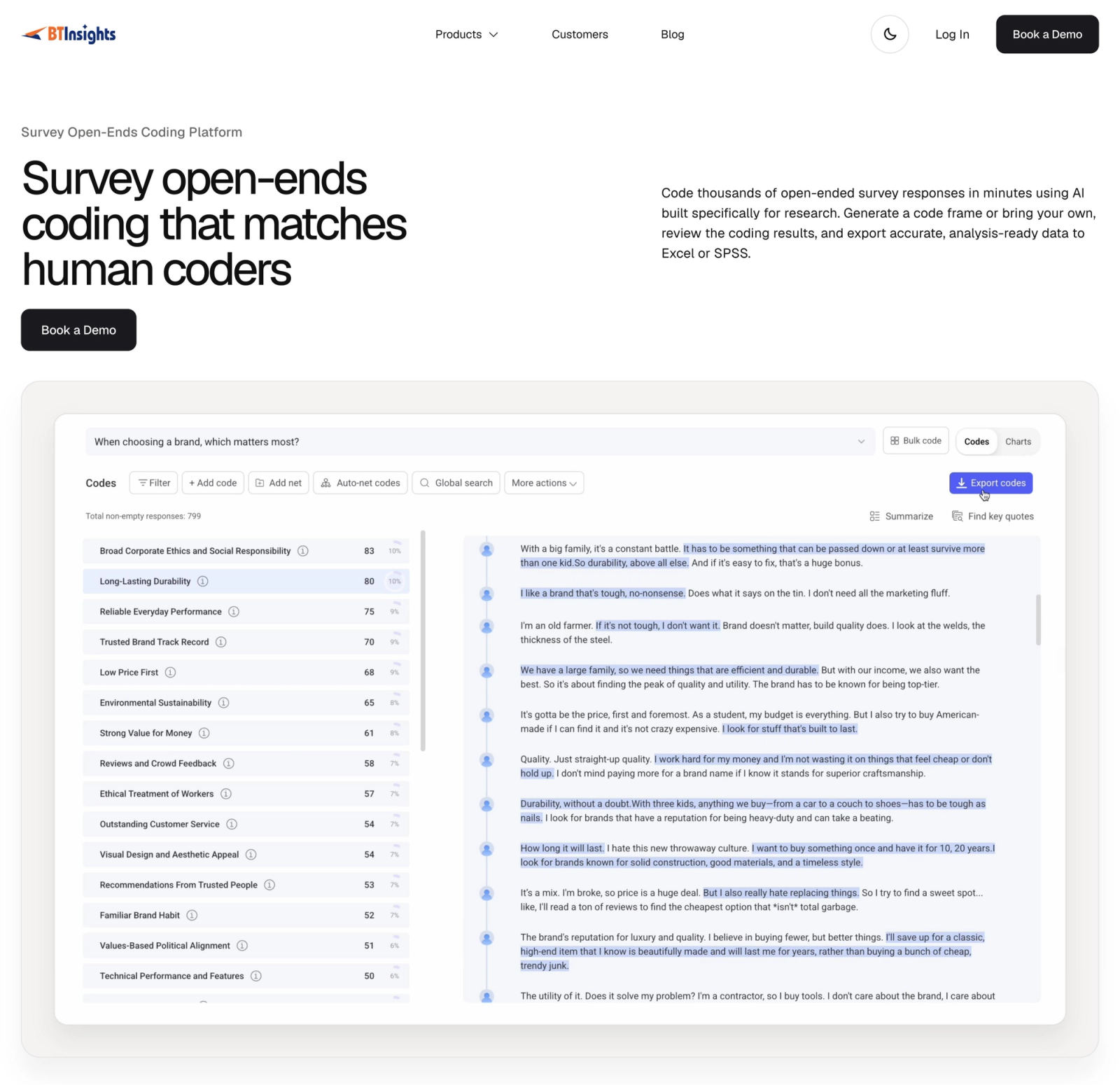
BTInsights is an AI-native platform for market researchers that covers the whole open-ends workflow, from the first code frame to crosstabs and follow-up questions. If your main frustration with Codeit is everything that happens after coding, this is where BTInsights stands out.
- Flexible code frames: Let AI build a code frame, or upload your existing codebook so tracker waves stay consistent.
- Entity and multi-code coding: Extract brands, places, and other entities, recognizing different names for the same one, and assign one or several codes per response.
- Review and edit: Check assignments response by response, then split, merge, rename, and group codes or move responses.
- Crosstabs and significance testing: Cut codes by segment and run significance tests in the same platform.
- Chat with your data: Ask follow-up questions of the responses, such as why one segment feels differently from the rest.
- Exports and slides: Export to Excel, SPSS, or Q, and turn crosstabs into editable PowerPoint slides in your own template.
BTInsights codes and translates responses in more than 50 languages. It's SOC 2 Type II audited, and customer data is never used to train AI models.
The UNH Survey Center uses it with client-supplied codebooks. The team uploads responses, applies the client's existing codes, reviews the results, and brings them back into Excel and SPSS. Project director Sean McKinley says the export “basically plugs in seamlessly with our existing Excel setup.”
Explore BTInsights Survey Open-Ends Coding.
2. Ascribe: Best for agencies with a dedicated coding team

Ascribe is one of the most established verbatim coding tools in market research and the most direct like-for-like alternative to Codeit. Ascribe Coder is built around codebooks, coder assignments, and project and team management, which suits agencies with full-time coding staff.
Its AI features include Theme Extractor, which builds a codebook with nets and codes, and Ask Ascribe, which answers plain-language questions about your data. Coding Assistant and Lightning Mode suggest codes based on earlier work, and Ascribe supports SPSS exports.
Keep in mind that crosstabs and trend reports live in Ascribe's separate CX Inspector product, and pricing isn't published. If you're leaving Codeit to get more analysis in one place, Ascribe may not close that gap.
3. Displayr: Best for quant-heavy teams that also code open-ends
Displayr is an analysis and reporting platform first. Its cross-tabulation, weighting, significance testing, and dashboards are its main strengths, and its text categorization tools let you code open-ends in the same environment.
The AI can find themes and assign one or several categories per response, existing code frames can be reused across variables, and custom AI prompts handle tasks like entity extraction and sentiment. Coded results can be charted and exported to PowerPoint, Excel, or PDF.
That makes Displayr a good answer to Codeit's analysis gap. The trade-off runs the other way: its review and editing tools for coding are lighter than a dedicated coding platform's.
4. Caplena: Best for ongoing CX and feedback analysis
Caplena analyzes open-ended feedback for CX, employee experience, and market research teams. It generates a codebook quickly, lets you refine topics by merging and renaming them, and works across more than 100 languages.
Data comes in from Excel, SPSS, or integrations including Qualtrics and Medallia. The Insight Agent answers questions about your feedback, and driver analysis shows which topics have the most impact on scores.
Caplena is strongest for continuous feedback programs. For project-based survey coding, confirm codebook import and export formats before you commit.
5. Qualtrics Text iQ: Best for Qualtrics-first teams
If your surveys already run in Qualtrics, Text iQ lets you analyze open text without exporting anything. You can create topics manually or with keyword queries, nest them into hierarchies, assign several topics to one response, and analyze topics against other variables in Stats iQ.
Advanced licenses add recommended topics and sentiment analysis. Text iQ supports 14 languages, and the Basic license limits each survey to 20,000 responses.
The truth is, Text iQ relies more on keyword logic than Codeit's AI does, so nuanced code frames can take more manual setup. It works best when staying inside Qualtrics matters more than coding depth.
6. Thematic: Best for discovering themes you didn't plan for
Thematic finds themes in feedback automatically, with no taxonomy to set up first. Themes are hierarchical, comments can carry multiple themes, and a theme editor lets you merge, rename, split, and add themes.
It also offers sentiment, translation, segment comparisons with significance testing, and an Answers feature for natural-language questions.
Thematic's discovery-first approach is useful for exploratory research, but teams applying fixed or client-supplied code frames should check how much control they have from the start.
How to test a Codeit replacement
Switching coding tools mid-program is risky, so test before you commit to see if it fulfills what you're looking for.
Here's a simple process you can use:
- Export your Codeit codeframe and load it into the new platform as a predefined code frame.
- Run a wave you've already coded through the new tool, including at least one brand or entity question.
- Compare results on the codes that matter most to your clients, not only overall agreement.
- Measure review time, since a slightly less accurate first pass that's faster to fix can still save more time.
- Finish the job in the new tool: crosstabs, significance tests, exports, and one client-ready output.
Abacus Data went through a similar shift. Its analysts export open-ends from Q, code them in BTInsights, and bring the results back into Q. On larger studies, coding that took about two weeks now takes around 20 minutes, and senior analyst Michael Monopoli says codes rarely need reassigning after review.
For a closer look at how AI coding accuracy is measured against human coders, see our test of two AI coding models on 2,617 human-coded responses.
Go From Coded Data to Findings Without the Handoffs
Codeit does the coding well. But when crosstabs, significance tests, and follow-up questions happen somewhere else, every project picks up extra exports and extra checking.
BTInsights was built to fix that.
- AI or existing code frames: Build a new code frame in minutes or apply your current codebook to every wave.
- Entity and multi-code coding: Capture brand mentions and every idea in a response, not just the main one.
- Analysis in the same place: Run crosstabs and significance tests on your codes, then chat with the responses to explain the numbers.
- Fits your stack: Export to Excel, SPSS, or Q, in more than 50 languages.
Bring a real dataset and see the difference. Book a demo with BTInsights.