


When Abacus Data surveys thousands of people, the answers to open-ended questions add invaluable depth and context to the numbers behind every study. But making sense of those answers used to demand a lot of time, and coding them by hand left analysts with less time to give those findings the attention they deserve.
We spoke with analysts Michael and Veronica about how Abacus Data uses BTInsights to code those responses, bring the results into its existing workflow, and spend more of its time on the insights clients need.
The Challenge: Thousands of Answers to Code by Hand
Before BTInsights, survey text analysis at Abacus Data was a fully manual task. Analysts worked through lists that could contain 1,500 to 2,000 responses, reading each answer and assigning it to the appropriate category. Some answers needed translation, and longer comments required a closer look to identify their themes.
The scale was especially difficult on Abacus Data’s generational research. Some studies could survey up to 10,000 people and produce thousands of open-ended responses, which could take analysts up to two weeks of full-time work to code manually.
The work didn’t end with assigning categories. As the team read more responses, they might realize that a topic they had been grouping under a broader code deserved its own category. That meant reconsidering earlier decisions while keeping the coding consistent across thousands of answers.
Abacus Data’s analysts also have other responsibilities on each project. Every day spent coding by hand was time they couldn’t spend using their expertise to interpret results and connect the dots for clients.
Coding Open-Ended Responses With BTInsights
Today, the team uses BTInsights’ Survey Open-Ends Coding Platform to automatically code written survey responses, giving analysts a structured starting point for their analysis.
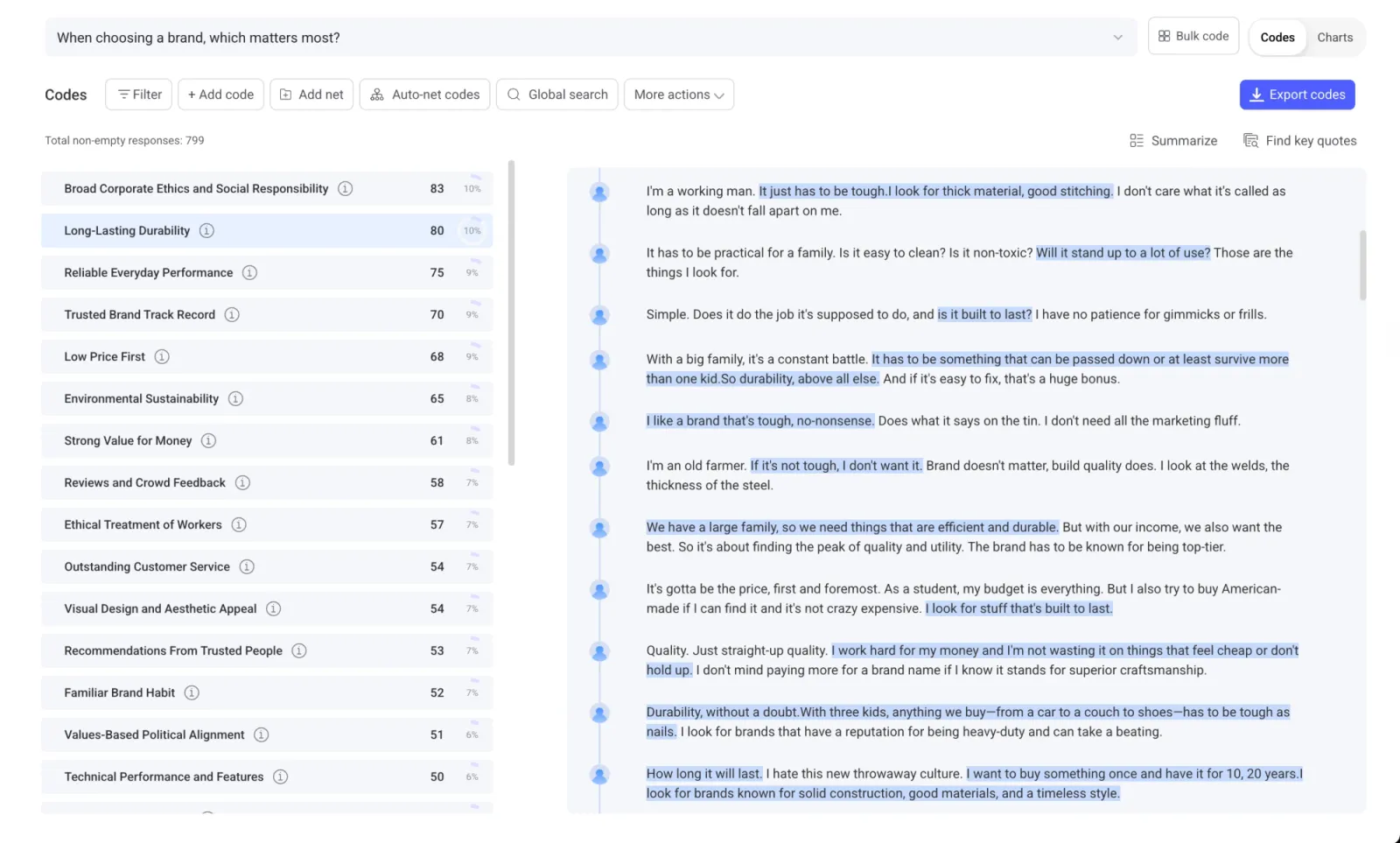
The platform fits into the team’s existing workflow, with analysts exporting their open-ended responses from Q, uploading them to BTInsights, and then bringing the coded results back into Q.
According to Veronica, that simple export makes a big difference to the team’s workflow.
It’s so easy to copy and paste the results back to Q, and we don’t have to spend extra time making sure everything’s aligned or putting in the codes manually.

The team still checks the output and considers what deserves attention in the client report. According to Michael, codes rarely need reassigning, but reviewing the responses still helps them pick out smaller themes worth examining a bit closer.
Keeping Analysts in Control of the Results
The analysts can also shape the coding around each survey question. For example, Michael uses bulk coding to run several questions at once after setting up each one separately, so they don’t have to share a single code frame. The team can also specify a category it wants to track, examine individual responses, and edit or add codes when a client’s priorities call for a closer look.
With those choices available, the team has the flexibility to use the features that suit each project and adjust them as needed.
As Michael put it, “The features are all incredibly helpful, but I also really love that you’re never confined by any of them. Anything can be turned off or edited to make it usable to you.”
The Result: More Time for Analysis and Client Reporting
For larger studies, manual open-ends coding once took analysts about two full-time weeks. With BTInsights, the initial coding takes minutes.
We used to spend around two weeks manually coding responses on some of our larger studies. Now, for some projects, we can get the responses into BTInsights, code them, and bring the results back into Q in around 20 minutes.

As Veronica puts it, BTInsights helps the team “really get into the value add for the client.” Instead of spending days on repetitive coding, analysts can spend more time understanding the findings and drawing out the insights the client wants from the report.
For Michael, the change is also about the scale of work the team can approach with confidence; “It turns big, overwhelming, scary projects into something that can be done.”
Spend More Time Adding Value for Clients With BTInsights
Open-ended answers can bring valuable context to a survey, especially when thousands of people have something to say. Abacus Data’s team can now move through the first stage of coding quickly, review the details that need attention, and put its time into explaining what the responses mean.
Want to see how BTInsights could fit into your team’s survey workflow? Book a demo to see the survey open-ends coding platform in action.