
In the data-driven business world, more than ever, the why behind customer opinion matters. And market researchers, management consultants, and leaders are increasingly relying on sentiment analysis tools. These AI-powered platforms automatically extract emotions from text at scale — be it from surveys, social media, reviews or a variety of other sources. The output? Insightful data that helps you understand whether the noise around your brand, topic or event is positive, negative or neutral — and why. The result: Deeper customer insights to guide strategy, improve customer experience and drive smarter decisions.
But with so many tools on the market to choose from, which one is right for you? In this article, we outline the best sentiment analysis tools of 2026. These sentiment analysis platforms are all stellar, but have different areas of focus. So, whether you need to analyze open-ended survey responses or want to track brand sentiment across the entire web, we’ve got you covered.
Top 8 Sentiment Analysis Tools in 2026
1. BTInsights – Best for interview and survey sentiment analysis
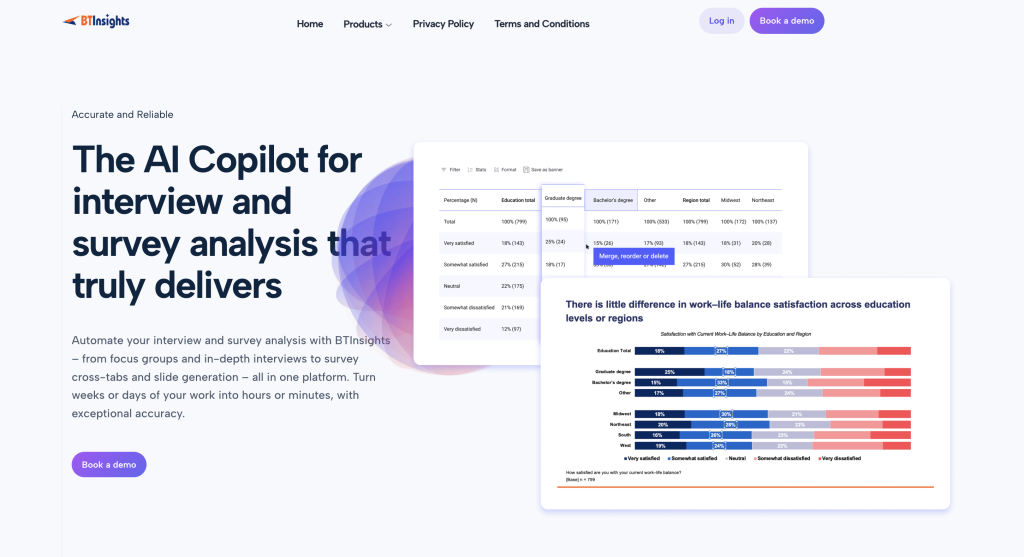
If you want to analyze qualitative data quickly and with the highest accuracy, BTInsights is the platform to use. BTInsights is a market research–specific tool built to help you gain the most insight from your in-depth interviews and open-ended survey responses. BTInsights can transcribe and analyze thousands of open-ended comments in seconds and surface high-quality themes and sentiments from text using AI. It also goes beyond most other general text analytics platforms in that every single insight on the BTInsights platform is traceable back to the source data – in other words, you can always trace a sentiment or finding back to the transcript or response that it’s from, avoiding any potential errors by the AI.
Why choose BTInsights?
If your research includes focus groups, customer interviews, or open-ended, free-form feedback that’s just too long for other types of analysis, BTInsights is for you. This platform provides actionable insights in record time with an exceptional level of quality, catching sentiment and the nuanced emotions and context of the words that many tools miss. Additionally, the AI copilot at the center of this platform ties all of your findings directly to supporting quotes and transcripts, providing you with deep, nuanced insights without sacrificing any transparency. In other words, with BTInsights, you can reduce weeks of manual analysis to just hours of work, all within a secure, single interface.
The AI Copilot for interview and survey analysis
Focus Groups – In-Depth Interviews – Surveys
2. Qualtrics XM – Best for enterprise customer feedback
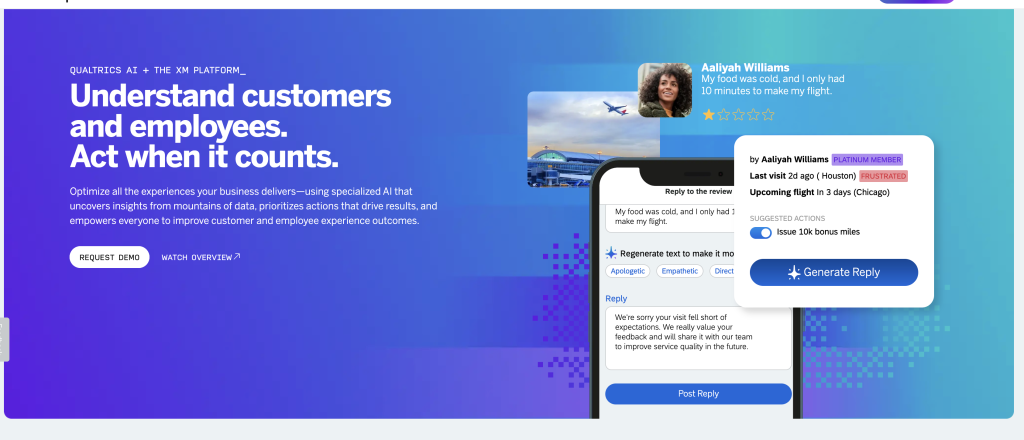
Qualtrics XM is a popular platform for enterprises seeking a voice-of-customer sentiment solution. It features advanced NLP for automatically organizing comments into themes and scoring sentiment – rather than simply flagging a review as negative, it can tell you why. The Text iQ engine can analyze multi-language text, and recognize nuanced sentiment, to ensure you’re not missing insights in translation.
Why choose Qualtrics?
Qualtrics is a great option for organizations already leveraging Qualtrics for surveys or broader experience management. Sentiment analysis tools have been battle-tested at the enterprise level – from categorizing thousands of open responses in minutes, to surfacing trending issues as they emerge in real-time. You also get powerful reporting tools to visualize sentiment trends and share actionable insights across the organization. For consultants managing enterprise workloads, Qualtrics offers a seamless way to link sentiment directly to broader customer experience metrics and dashboards.
3. Medallia – Best for omnichannel experience sentiment
Medallia is another major player in the experience management space, that aims to capture sentiment from all channels. Medallia can intake information from social and web reviews, surveys, chat transcripts, call center recordings, and even analyze the sentiment shared in each. Medallia’s AI can detect the emotion customers share in text, speech, or even video responses to get a 360-degree look at how customers are feeling. Medallia also excels at real-time analysis – for instance, Medallia could send an alert as soon as you notice a surge of negative mentions on social media.
Why choose Medallia?
If you’re a company that requires real-time monitoring of sentiment at all customer touchpoints, Medallia is tough to beat. A market research team, for example, could monitor overall customer sentiment in real time about a new product launch across all channels, from Twitter and Facebook posts to support calls, all in one dashboard. Medallia can identify sentiment related to specific topics or parts of the customer journey to see what exactly is leading to positive or negative sentiment. The tools that Medallia has for dashboards and AI insights are focused on being actionable, so consultants can easily spot bottlenecks and provide recommendations for improvements.
4. Zonka Feedback – Best for multi-channel feedback analysis
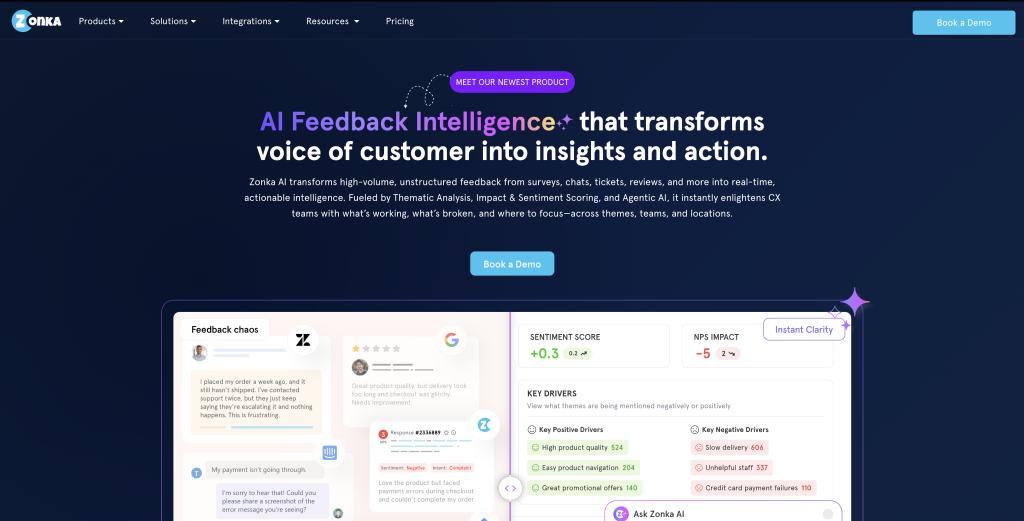
Zonka Feedback is a customer experience and survey platform that helps capture and analyze feedback from email, SMS, websites, mobile apps, and offline channels. With its focus on streamlined feedback collection across multiple channels, Zonka Feedback is a popular choice for teams that need both survey infrastructure and sentiment analysis capabilities in the same platform.
Sentiment scoring for open-ended responses is applied automatically and responses are labeled as positive, negative, or neutral based on AI-driven text analytics. Users can then drill into the results by question, channel, location, or customer segment. Its intuitive dashboard with customizable survey templates and automated workflows can help organizations quickly detect issues and implement improvements.
Why choose Zonka Feedback?
Zonka Feedback is a popular choice if you’re already running more structured feedback programs, such as NPS, CSAT, or post-transaction surveys, and you want an easy way to capture scores and the qualitative sentiment behind those ratings. Market researchers will also like the platform’s ability to slice and dice sentiment by touchpoint or demographic to do deeper “why behind the score” analysis. Consultants and researchers also like its easy-to-use reporting tools that let you quickly turn research results into client-ready formats. Zonka’s sentiment analysis isn’t as sophisticated or nuanced as the offerings from more specialized, AI-first platforms, but it’s a great fit when you need survey delivery + feedback analytics + sentiment scoring in one platform.
5. Lexalytics – Best for customizable NLP analytics
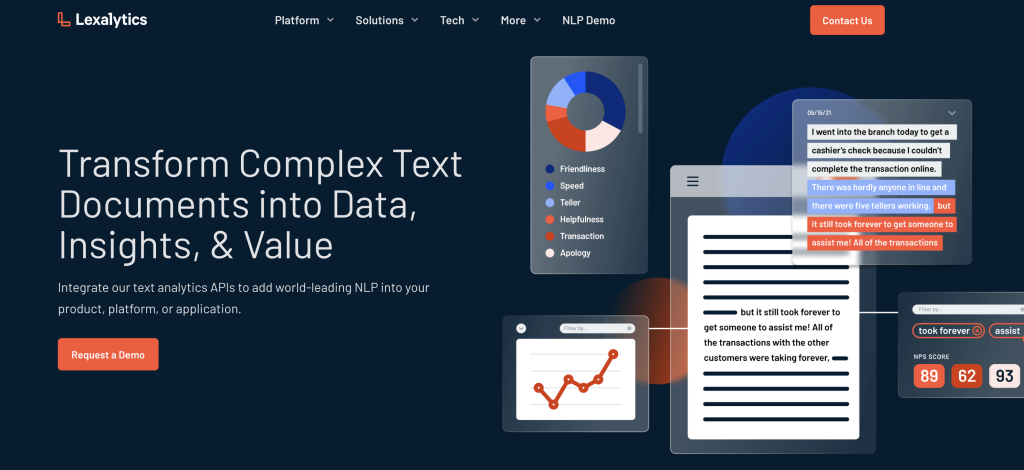
Lexalytics could be considered the “engine under the hood” of sentiment analysis. This text analytics API/toolkit is more for advanced users than an out-of-the-box app, but worth noting because many tools use Lexalytics under the hood for their sentiment processing. Lexalytics (via Salience and Semantria) offers deep customization for businesses that need to tune up sentiment models, add custom dictionaries (such as industry-specific jargon/slang, etc), and tailor how scoring works. Lexalytics also provides advanced NLP features such as entity recognition, theme extraction, and part-of-speech tagging.
Why choose Lexalytics?
If ultimate control over your sentiment analysis is important – perhaps you’re building your own proprietary insights platform, or have highly domain-specific language to be analyzed – then Lexalytics is a great foundation to build on. Its API can be integrated by developers and data science teams and baked right into your own applications. While it’s not the most intuitive user interface for an everyday user, Lexalytics technology actually powers many other tools on this list, and has been battle-tested for accuracy and performance. It’s a reliable option to choose when your priorities lie in customization and/or integration into your existing workflows, rather than a ready-made dashboard.
6. Brandwatch – Best for social media sentiment & emotion analysis
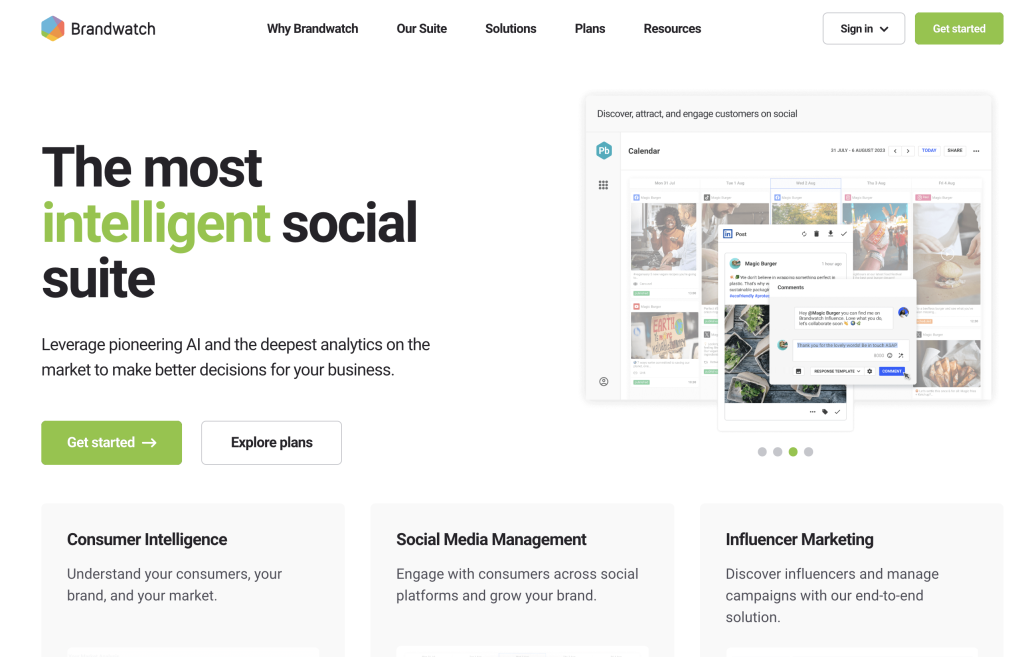
Brandwatch is great for gaining deep insights into social media sentiment. It’s particularly adept at understanding the unstructured and informal language found on social networks – slang, emojis, dialects and all. Brandwatch tracks what people are saying about your brand (or anything else) by monitoring millions of sources (Twitter, Facebook, Instagram, forums, blogs, news, etc.). Its sentiment analysis goes beyond simple positive/negative, and can actually dissect conversations by emotion. Brandwatch can detect different feelings such as anger, disgust, fear, joy, and surprise present in the data. It supports 40+ languages, so it’s definitely global in scope, and you can also customize sentiment classifications if you need to.
Why choose Brandwatch?
If you need to monitor brands or do social listening at scale, then Brandwatch can provide an enterprise-grade solution. Market researchers can monitor public response to a campaign or new product launch, and track sentiment in real time by demographics and location. Its advanced analytics can help you pinpoint not just that sentiment shifted, but why it did. For example, if there’s a spike in negative sentiment, a deep dive into the most relevant conversations might show that most of this negativity is due to a particular problem with one product, and not something else entirely. Brandwatch’s emotion analysis is also more nuanced than a straight positive/negative score. This level of detail is a potential goldmine for targeted marketing campaigns or PR strategy work. If you’re a consultant working with large brands with a major online presence, it’s a rock-solid option.
7. Talkwalker – Best for broad listening across languages
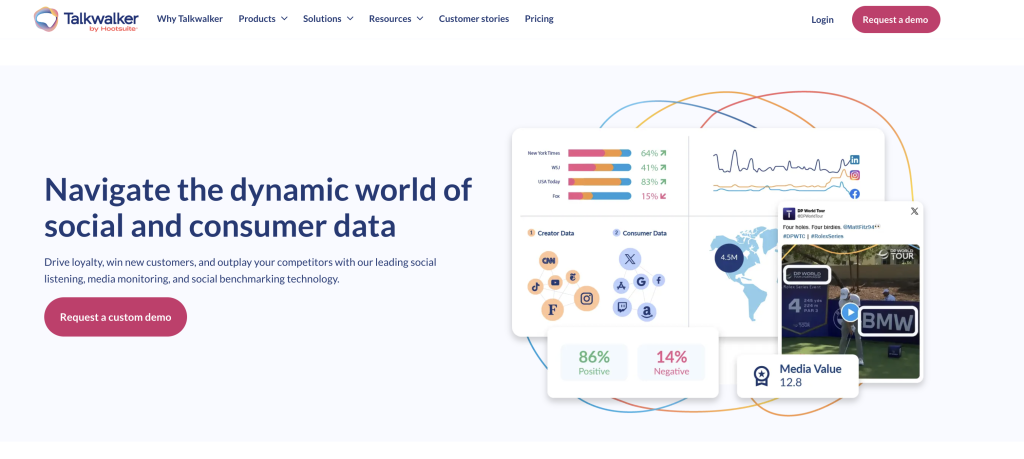
Talkwalker is another high-end social listening tool known for its broad data coverage and robust analytics. Talkwalker’s tech is so well-regarded that some other tools actually use it as the backbone of their sentiment features (like Hootsuite’s built-in sentiment analysis). It listens for sentiment across 150 million data sources, which is in addition to more than 30 social networks, and includes blogs, forums, news sites, and review pages. Talkwalker is built for large, global organizations and has deep language and regional support. The platform uses AI to pick up sarcasm or slang and tag it accordingly. It also has some unique features for “product sentiment”, which breaks down overall sentiment into the various attributes of a product or topic (so you can see exactly which features are a hit or miss with your audience).
Why choose Talkwalker?
Talkwalker is for anyone who needs highly expansive coverage beyond just top social media platforms. It is popular with PR agencies and marketing teams that want to monitor brand reputation or listen for potential crises across the entire web. Market consultants may use Talkwalker to help benchmark their clients’ sentiment against their competitors, since Talkwalker can easily pull in so much comparative data. It’s also worth noting that the platform’s dashboards let you break the data out by region, topic, or source, which is nice if you want to mix-and-match the way you view and analyze data. If you need a comprehensive, multilingual listening solution with advanced analytics – and have a bigger budget to work with – Talkwalker is an excellent option.
8. Sprout Social – Best all-in-one social media management with sentiment
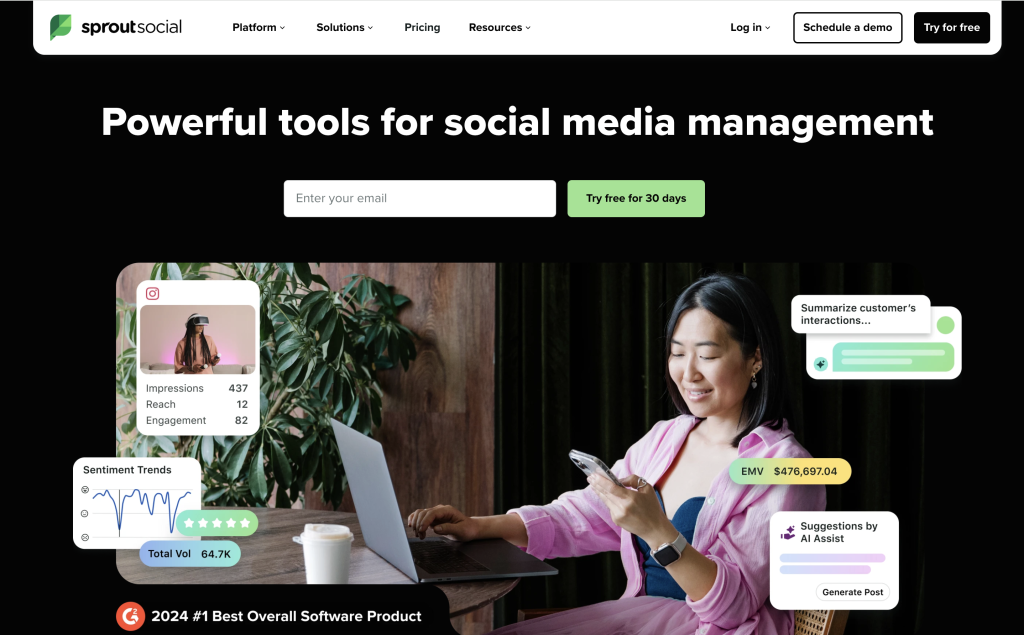
Sprout Social is perhaps best known as a social media management platform, but it’s also an excellent option for listening and AI-powered sentiment analysis. Sprout is a “swiss army knife” social media tool: you can schedule and post content, engage with your audience, and track your sentiment across all your social channels in one central tool. It automatically tags your incoming messages and mentions by sentiment (positive, negative, neutral) and it also detects sarcasm or emoticons to a degree. It supports sentiment analysis for multiple languages as well, which is ideal for more international brands with audiences in different languages. You can see sentiment trends over time and set up alerts for spikes in negative sentiment.
Why choose Sprout Social?
If you or your client already have a heavy social media operation going on, Sprout hits two birds with one stone by providing both the ability to manage day-to-day social media in one place as well as providing more nuanced sentiment intelligence. This can be especially helpful for customer care or community management teams who want to prioritize their responses based on the sentiment behind each post (eg. attending to negative comments before positive ones). As a consultant, Sprout’s reports can help you visualize almost immediately how your campaigns are being felt emotionally by your audience. If your client or organization doesn’t already have Sprout, the biggest downside is that it probably won’t have the utmost depth of a dedicated analytics only tool, but it’s much more user friendly and provides most organizations with more than enough
Frequently Asked Questions (FAQ)
Q1. What are sentiment analysis tools and how do they work?
A1. Sentiment analysis tools (sometimes called sentiment analyzers or tools) are typically software applications that use machine learning, NLP, and other AI technologies to automatically classify textual data as having positive, negative, or neutral sentiment (emotional direction). Applied, these solutions mine your social media, survey, email, review, etc. text content and analyze words, phrases, and context to identify the perceived attitude expressed in the text. Many advanced tools can identify specific emotions (joy, anger, frustration, etc) and intent. They typically work by identifying sentiment-laden keywords or phrases in the content as well as grammar and proximity patterns related to those words. Modern sentiment analysis software leverages AI language models (for example, transformers) that are trained on large volumes of text to parse context to better understand things like sarcasm or idioms. The result of the process is that humans can quickly and easily gauge how people feel about something as expressed in text-based feedback at scale, helping your company to better understand how your customers feel at a high level.
Q2. How accurate are sentiment analysis tools, and can they detect sarcasm or nuance?
A2. Sentiment analysis tools are getting much more accurate with recent AI breakthroughs, but they aren’t quite perfect. The best commercial products are now usually over 80-90% accurate in classifying plain positive or negative statements correctly and will use more advanced models and context understanding to improve detection of polarity or emotion. Nuanced language (sarcasm, irony, slang, or context-dependent language) can still trip them up, however. For example, a sentence like “Oh great, another delay” might be picked up as positive by a simple keyword-based algorithm because of the word “great,” while it’s clearly negative from the rest of the context. Some sophisticated social media analytics platforms such as BTInsights have tried to address this with methods that analyze the full context and use state-of-the-art models that are trained on more nuanced data (some even say they can detect basic sarcasm). Keep in mind that you should still expect a certain error rate, particularly with very subtle, coded, or even culturally specific language that may be non-standard. The good news is that many tools allow for human quality assurance – that is, users can go back and correct sentiment tags to continually improve the overall system accuracy. In other words, sentiment tools give a very useful approximation of tone, and as long as you understand their limitations, these tools should be quite reliable for macro-level analysis. For mission-critical decisions you may still want to manually verify any questionable cases of particularly subtle or humorous language.
Q3. How should I choose the best sentiment analysis tool for my needs?
A3. A good first step is to think about where your text data comes from and what you hope to learn from it. Some sentiment analysis tools are geared towards social media text, while others focus on surveys or reviews, some support real-time streams and others are more for batch historical analysis. Some of the key differentiators to look at are as follows.
- Accuracy & Nuance: Can the tool accurately process the languages you need, and does it support context-dependent or tone-sensitive analysis (like sarcasm)? The best options will offer high levels of accuracy and even aspect-based sentiment analysis for deeper analysis.
- Data Sources & Integration: Can the tool ingest all the platforms/sources you’re interested in (Twitter, online forums, your own customer feedback CRM data, etc) and integrate with your existing systems?
- Scalability & Speed: If you have a large volume of text to analyze or you need real-time monitoring, choose a tool that can scale and run quickly. Some enterprise-level solutions can handle billions of pieces of text data in real time with no lag.
- Reporting & Visualization: How are the results and insights displayed – is it easy for you to communicate them to others? Clear dashboards and charts are a must for easy analysis and the BTInsights platform, for example, can allow you to export your sentiment analysis results in PowerPoint slides that are presentation-ready for your client.
- Budget & Support: Obviously, you want to choose a tool that fits your budget but also check what level of support is provided. Enterprise tools will come with dedicated support and more bells and whistles, while there are more cost-effective options that may be adequate for your project.
In summary, the best tool for you will be one that matches the above strengths to your own use case. If possible, try to use free trials or demos to get a feel for the tool using your own data before making a final decision.
The AI Copilot for interview and survey analysis
Focus Groups – In-Depth Interviews – Surveys